
Artificial Intelligence & Automation are transforming how businesses operate, how professionals make decisions, and how students prepare for the future. If you’ve ever wondered how AI tools generate content, how automation saves companies thousands of hours, or how you can build a career in this field this pillar guide is your starting point.
At Wamid Academy, we believe structured and practical learning helps learners move from confusion to confidence. In this complete guide, you’ll understand Artificial Intelligence & Automation, explore machine learning and generative AI, learn how AI agents work, and discover a clear AI career roadmap you can follow.
📚 Table of Contents
- What Is Artificial Intelligence & Automation?
- What Is Artificial Intelligence?
- What Is Machine Learning?
- Types of Machine Learning
- What Is Generative AI?
- AI Agents Explained
- What Is Automation?
- Real-Life Applications of Artificial Intelligence & Automation
- AI Career Roadmap
- Benefits and Risks of Artificial Intelligence & Automation
- Frequently Asked Questions
What Is Artificial Intelligence & Automation?
Artificial Intelligence & Automation refer to technologies that enable machines to perform tasks intelligently and automatically.
- Artificial Intelligence (AI) allows machines to simulate human thinking.
- Automation allows systems to perform tasks without constant human intervention.
When combined, Artificial Intelligence & Automation create systems that can analyze data, make decisions, and execute actions all while improving over time.
What Is Artificial Intelligence?
Artificial Intelligence is a branch of computer science focused on building systems that can:
- Learn from data
- Recognize patterns
- Make predictions
- Solve problems
Simple Definition
Artificial Intelligence is the ability of machines to mimic human intelligence.
Examples:
- Chatbots
- Voice assistants
- Fraud detection systems
- Self-driving vehicles
AI is powered by algorithms and data. According to research from Stanford University, AI adoption across industries has grown rapidly over the past decade.
What Is Machine Learning?
Machine Learning (ML) is a subset of Artificial Intelligence.
Instead of being explicitly programmed for every rule, machine learning models learn from data.
If you’d like a deeper, beginner-friendly breakdown with practical examples, read our complete guide:
What Is Machine Learning? A Beginner-Friendly Guide With Real Example
Real-Life Example: Email Spam Filter
- The system sees thousands of emails.
- It learns patterns of spam.
- It predicts whether new emails are spam.
- It improves as it receives feedback.
This is AI in action through machine learning.
Key Machine Learning Concepts
| Concept | Meaning |
|---|---|
| Dataset | Collection of training data |
| Model | Mathematical function that learns |
| Training | Teaching the model using data |
| Prediction | Output produced by the model |
Types of Machine Learning
Understanding the types of machine learning is essential before going deeper into Artificial Intelligence & Automation.
1️⃣ Supervised Learning
- Uses labeled data
- Examples: spam detection, price prediction
2️⃣ Unsupervised Learning
- Finds hidden patterns
- Examples: customer segmentation
To understand the difference clearly with real-world comparisons and visuals, explore:
Supervised vs Unsupervised Learning Explained for Beginners
3️⃣ Reinforcement Learning
- Learns by reward and punishment
- Examples: robotics, game AI
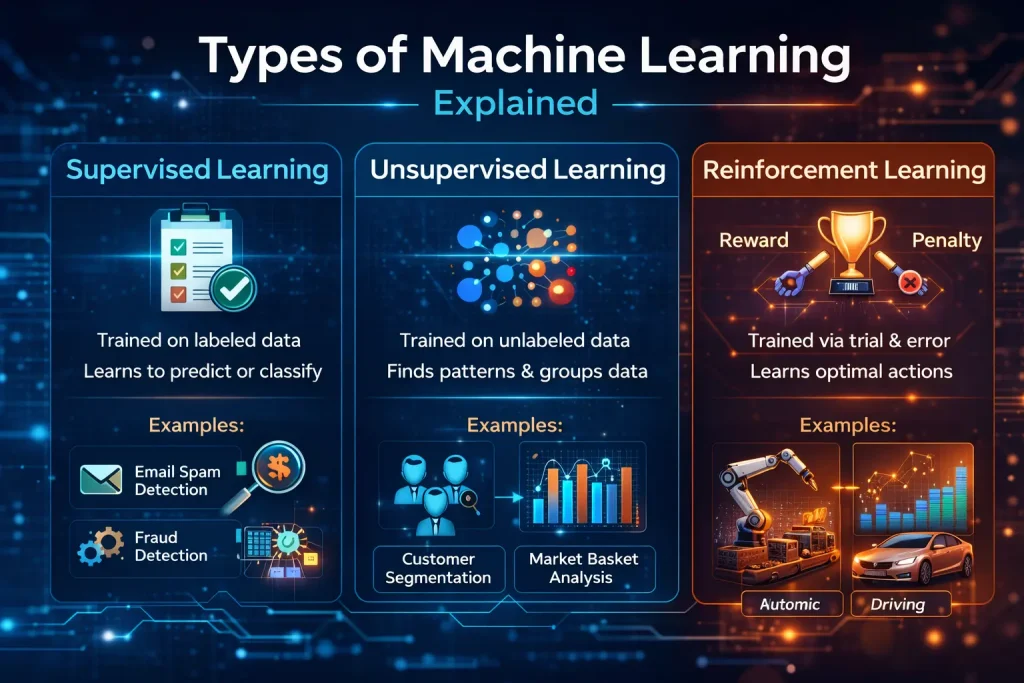
These learning methods form the foundation of modern AI systems.
What Is Generative AI?
Generative AI is a specialized branch of Artificial Intelligence that creates new content.
Examples:
- Text generation
- Image generation
- Code generation
- Music creation
Unlike traditional AI systems that classify or predict, generative AI produces original outputs.
Applications of Generative AI
- AI content writing tools
- AI-powered design assistants
- Automated marketing copy
- Coding copilots
This is one of the fastest-growing areas in AI & automation technologies today.
AI Agents Explained
AI agents are systems that:
- Observe their environment
- Make decisions
- Take actions
- Learn from outcomes
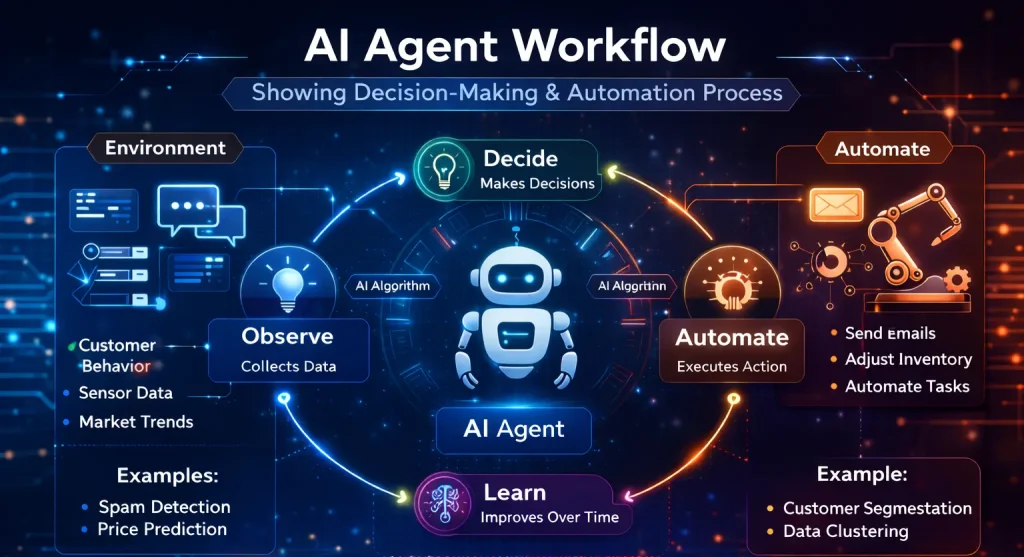
Example: AI Sales Assistant
- Monitors customer behavior
- Predicts buying intent
- Sends automated follow-ups
- Improves conversion rates
AI agents combine machine learning + decision-making + automation.
At Wamid Academy, we emphasize understanding how AI agents operate because they represent the future of intelligent automation systems.
What Is Automation?
Automation refers to technology that performs tasks automatically.
Types of Automation
| Type | Description | Example |
|---|---|---|
| Rule-Based | Predefined logic | Invoice generation |
| Process Automation | Workflow automation | HR onboarding |
| Intelligent Automation | AI-enhanced automation | Fraud detection |
Automation alone does not learn. When integrated with AI, it becomes powerful.
Real-Life Applications of Artificial Intelligence & Automation
Healthcare
- Medical image analysis
- Early disease detection
Finance
- Fraud detection
- Algorithmic trading
Education
- Personalized learning systems
- Automated grading
Business Operations
- AI-powered workflow automation systems
- AI tools for business productivity
Artificial Intelligence is also transforming traditional tools like spreadsheets. If you work with Excel, you should explore:
Stop Learning Excel, Meet the AI Spreadsheet Revolution
To see how AI is changing Excel in 2026 with real examples and tools, read:
The AI Revolution in Excel: Latest Trends Transforming Spreadsheet Work in 2026
For broader insights into global AI adoption, see research from McKinsey & Company.
AI Career Roadmap
If you want to build a future-proof career in Artificial Intelligence & Automation, follow this structured roadmap.
Step 1: Learn Foundations
- What is Artificial Intelligence?
- What is Machine Learning?
- Basic statistics
Step 2: Learn Programming
- Python
- Data analysis tools
- Basic algorithms
Step 3: Build Projects
- Spam classifier
- Chatbot
- Simple automation tool
Step 4: Choose a Specialization
| Path | Role Examples |
|---|---|
| Machine Learning | ML Engineer |
| Data Science | Data Analyst |
| Generative AI | Prompt Engineer |
| Automation | RPA Developer |
| AI Security | AI Governance Specialist |
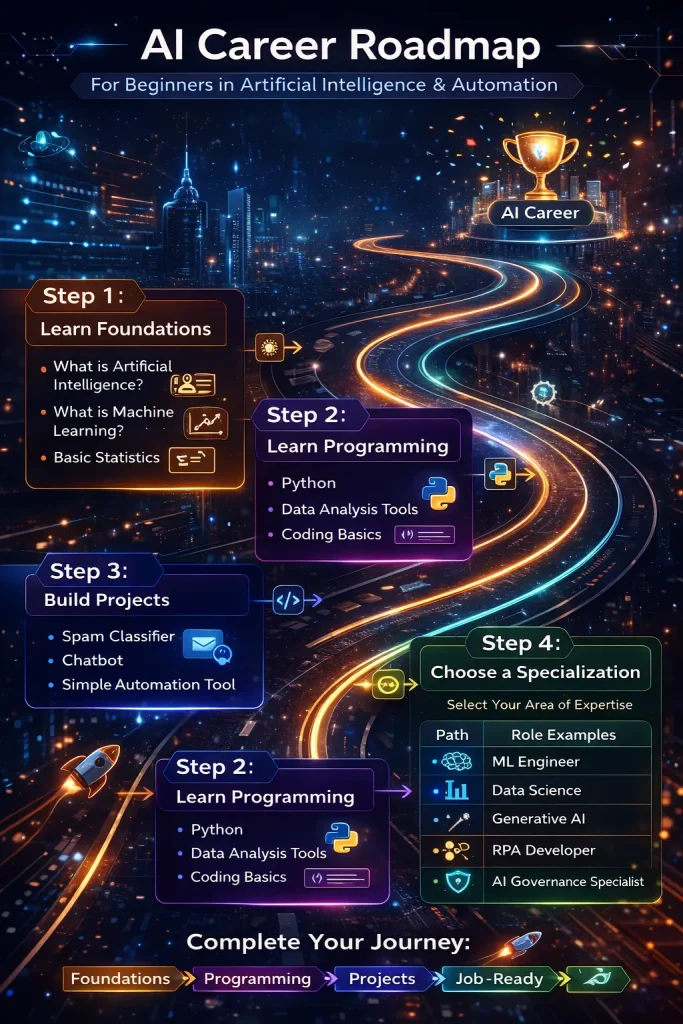
At Wamid Academy, we design structured learning paths that help beginners move toward job-ready AI skills step by step.
Benefits and Risks of Artificial Intelligence & Automation
Benefits
- Increased productivity
- Reduced costs
- Faster decision-making
- Scalable systems
Risks
- Ethical concerns
- Data privacy issues
- Bias in AI models
- Workforce disruption
Organizations like World Economic Forum actively discuss responsible AI governance.
Frequently Asked Questions
Automation executes tasks automatically. Artificial Intelligence enables systems to learn and make decisions.
Yes. Machine learning is a subset of AI that enables systems to learn from data.
Python, statistics, problem-solving, and understanding machine learning fundamentals.
With structured guidance and consistent practice, beginners can understand core AI concepts within 3–6 months
Build Your Future with Artificial Intelligence & Automation
Artificial Intelligence & Automation are not optional skills anymore they are essential competencies for the modern world.
This pillar guide introduced the foundations. In the next cluster articles, we will go deeper into:
- Machine learning algorithms
- Generative AI tools
- AI agent frameworks
- Advanced automation systems
At Wamid Academy, we guide learners from fundamentals to real-world implementation.
Explore more AI and Machine Learning courses at Wamid Academy and start building your future today.